
The process and calendar: from a proposal to cash
The steps between a policy idea and money in a hospital account, the 2027 legislative dates, the federal review routes, and why no payment date is promised.
About 5 minutes to read
The public calendar
- Legislature / Governor
- Federal Medicaid
- Project goals
The next four weeks
November–December 2026
- November 18Revenue forecast
- December 1Governor’s budget; LC drafts due
- December 1–3Legislative Days
- December 11Presession filing deadline, 5 p.m.
The three-year view
2027
Long session
- January: work requirements*
- Oregon six-month waiver: through September 30
- October: tax limit falls*
Designation in statute. Then local financing and OHA groundwork.
2028
Short session
- January: grandfathered directed payments start phasing down*
Targeted fixes; financing and federal review work.
2029
Long session
- Financing phase-downs continue
Payment target in the 2029–31 budget.
Project goals are proposed; passage, approvals and payment dates are not promised.
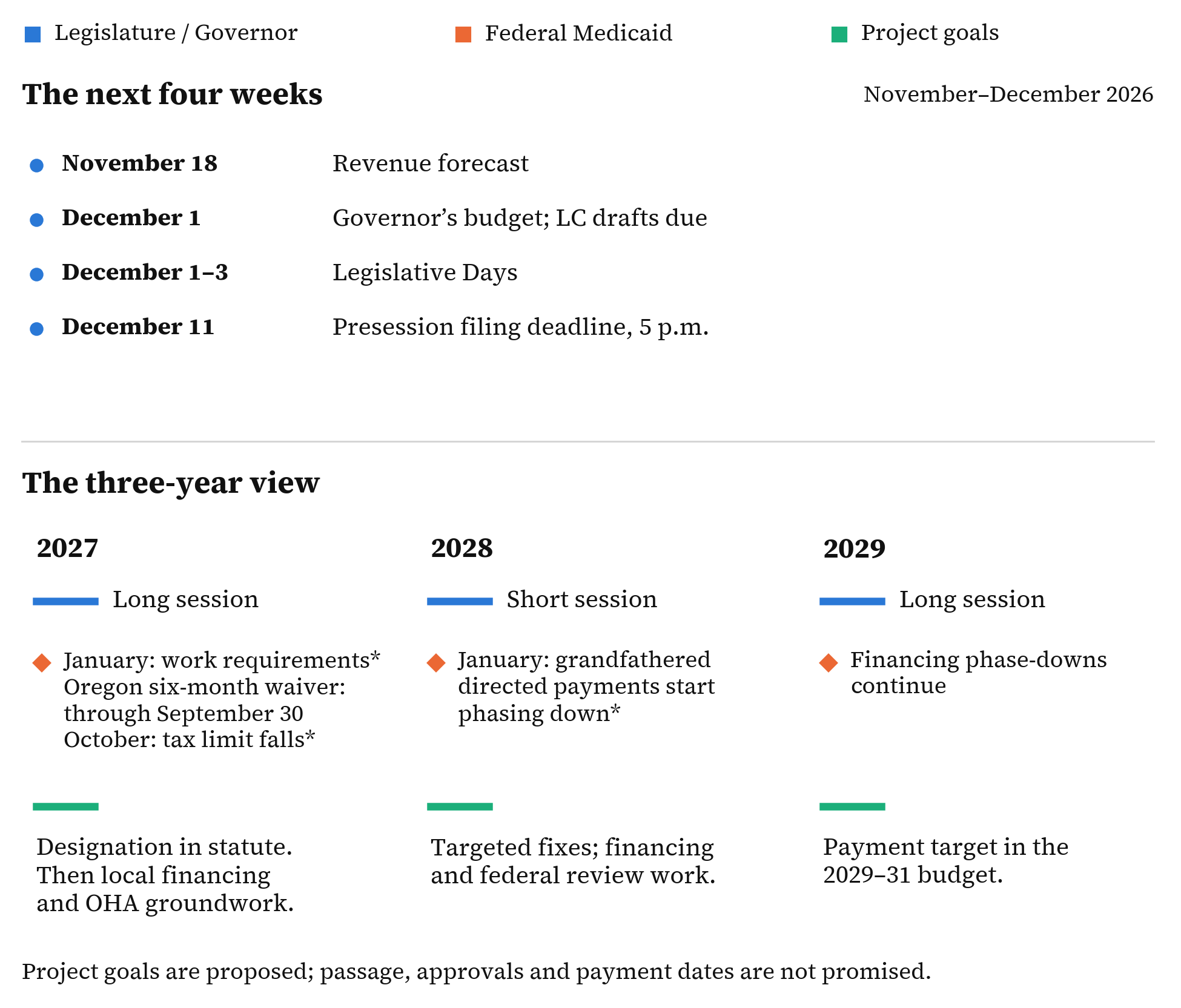
Public record. The near-term dates are November 18, 2026 for the revenue forecast; December 1 for the Governor’s budget and ordinary Legislative Counsel draft delivery; December 1–3 for Legislative Days; and December 11 for ordinary presession filing. The draft-delivery and filing deadlines are at 5 p.m. and remain subject to SCR 209’s exceptions. Sources: SCR 209, paragraph 3(b)–(c); Oregon 2027–29 Budget Instructions; November 2026 City Administrator update, state calendar.
Public record. Work requirements begin in January 2027 for affected adults, subject to exclusions and exceptions. Oregon’s approved waiver defers six-month redeterminations through September 30, 2027 for the specified adult-group members covered by expanded continuous eligibility. It does not waive all OHP renewals. The provider-tax threshold begins to fall in October 2027. Qualifying grandfathered directed payments begin their annual ten-percentage-point transition with rating periods starting on or after January 1, 2028; the separate ceiling for new covered arrangements already applies to rating periods beginning on or after July 4, 2025. Sources: CMS Oregon waiver, September 25, 2026, p. 9, § 7; CMS bulletin, November 18, 2025; CMS directed-payment guidance, February 2, 2026.
Proposed project goals. The calendar aims at a designation in 2027, subsequent financing and implementation work, and payment support in the 2029–31 budget. These goals do not promise passage, approval, a particular payment amount or a deposit date. A lawful and funded instrument could produce a different timetable.
The sequence matters
Analysis. A hospital funding proposal does not become revenue when someone writes a bill or announces support. It must move through decisions, funding, implementation and payment. The calendar is useful only when it says what each milestone accomplishes and what remains to be done.
The proposed Systemically Important Rural Hospital designation is one part of that sequence. It could identify an eligible class. It would not by itself establish a payment, supply money or complete federal review. Those steps need their own authority and evidence.
This winter: turn the concept into a reviewable proposal
Public record. Oregon has adopted deadlines for ordinary 2027 presession measures. Legislative Counsel is to deliver drafts to requesters by December 1, 2026, and requesters are to file them with the appropriate legislative desk by December 11. The resolution includes specified exceptions, so the ordinary deadline is not a statement that every possible legislative route disappears afterward. Source: SCR 209, presession deadlines.
Analysis. A request for a draft still needs its own record. Evidence that a request was sent does not prove that Legislative Counsel accepted it, assigned a number or returned a particular text. A returned draft must be checked for the actual hospital class, payment method, funding source and effective date.
Analysis. Election certification and legislative organization are separate events. This page does not treat unofficial election outcomes as settled committee assignments or leadership decisions. The relevant official records will determine who holds each role.
During the session: connect policy with funding
Public record. The regular session begins January 19, 2027 under Oregon's statutory convening rule. The ordinary 160-day constitutional limit reaches June 27, although the constitution provides for extensions. Committee work-session deadlines determine when many policy measures must move; the adopted 2027 schedule must be used when available. Sources: ORS 171.010; Official legislative foreword.
Analysis. A public hearing allows evidence and testimony. A work session allows a committee to act. A spending proposal also needs fiscal analysis and a budget route, usually involving Ways and Means. The fiscal statement should account for administration, data systems and implementation, as well as the proposed hospital payment.
Analysis. A budget note can communicate legislative expectations, but it is not a substitute for a payment statute or appropriation. Final budget legislation must match the policy that actually passes. A proposal can survive a policy discussion and still lack the funding needed to operate.
After passage: build the payment system
Public record. Oregon's default statutory effective date is January 1 of the year after passage unless the act provides otherwise. An earlier start therefore needs suitable express authority. Source: ORS 171.022.
Analysis. Even an effective law may require OHA rules, payment instructions, contracts, actuarial work and federal review before money moves.
Public record. The federal process depends on the design. A state-plan amendment changes Oregon's approved Medicaid plan. A directed payment governs specified payments through managed-care plans. Some minimum fee schedules do not require a separate directed-payment preprint, but they still have other requirements.
Public record. These review clocks are not interchangeable. The state-plan process generally has a 90-day action period that can restart after an information request. CMS's directed-payment process does not guarantee a decision within 90 days. A complete submission and a proposed start date are not the same as approval. Sources: 42 CFR 430.16; CMS directed-payment guidance.
When could a hospital receive money?
Analysis. The current project target is payment support in the 2029–31 budget. Calendar 2028 remains an earlier, route-specific planning scenario for a funded Medicaid method enacted in 2027, assuming timely data, state authority and successful required review. Neither is a promise. Claims processing, reconciliation and the actual payment terms can put cash later than the service date.
Analysis. A direct state-funded grant might operate sooner if the law's effective date, appropriation and agreement permit it. A cost-based method may make provisional payments and settle later. A guarantee follows a borrowing transaction and still leaves repayment obligations. These tools should not share a single undifferentiated “funding date.”
The next two years
Analysis. The 2028 short session can address limited implementation changes and budget adjustments. Federal advocacy, if separately chosen, should pursue a defined change and a demonstrated benefit. It should not be assumed to suspend the federal rules already governing state implementation.
Analysis. The 2029 long session can use access evidence and receipts from any earlier measures to refine eligibility, payment and financing. Where payments have not begun, it must use the verified baseline and identified estimates instead. That is the point to distinguish a temporary bridge from durable policy and to fund the next period accordingly.
Analysis. The hospitals' work runs through every stage: usable data, authorized governance decisions, accurate testimony and review of public explanations. “Too big to be small, too rural to be big” explains the problem. A credible calendar shows how a chosen response could become an actual, verified result.
Five questions
- Does a bill's introduction mean money is coming? No. Authority, funding, implementation and payment remain separate.
- Is 2028 a guaranteed payment year? No. It is an earlier conditional scenario; the current project target is the 2029–31 budget. The selected method and completed prerequisites govern both.
- Does CMS have to approve a directed payment within 90 days? No. Do not confuse its review goal with the separate state-plan process.
- Can a state grant move faster? Potentially, if effective authority, funds and an agreement exist; it has no automatic federal match.
- What can change the calendar? The final design, budget, data, rules, litigation, required approvals and actual operational readiness can each move it.
Public sources
- SCR 209, presession deadlines
- ORS 171.010 and 171.022, convening and effective dates
- Official legislative foreword, constitutional and statutory explanation
- Oregon legislative process
- 42 CFR 430.16, state-plan action
- CMS directed-payment guidance
- CMS-2449-P, procedural discussion and proposed changes
- Oregon Secretary of State, election certification
Evidence date and scope
Circulation draft published November 15, 2026. Earlier source dates and qualifications are retained. Public facts link to their original public sources; analysis, project positions and open questions are labeled. A reference to a hospital or other organization describes public information and does not mean that it has joined this project or endorsed its proposals.